What is Fulfillment? Everything an Online Seller Needs to Know
Global e-commerce crossed $6.3 trillion in 2024 and shows no signs of slowing down. Yet the single biggest bottleneck for growing online stores is not marketing or product development — it is logistics. Packing boxes, printing labels, queuing at the post office, handling returns. Fulfillment exists to remove that bottleneck entirely, so you can focus on what actually grows your business.
Fulfillment explained in 30 seconds
Fulfillment is the entire chain of physical steps that happen after a customer clicks “Buy” — storing inventory, picking the right item, packing it, shipping it, and managing any returns. When people say “outsourced fulfillment” or “3PL” (third-party logistics), they mean handing that chain to a specialist company so the seller never touches a box.
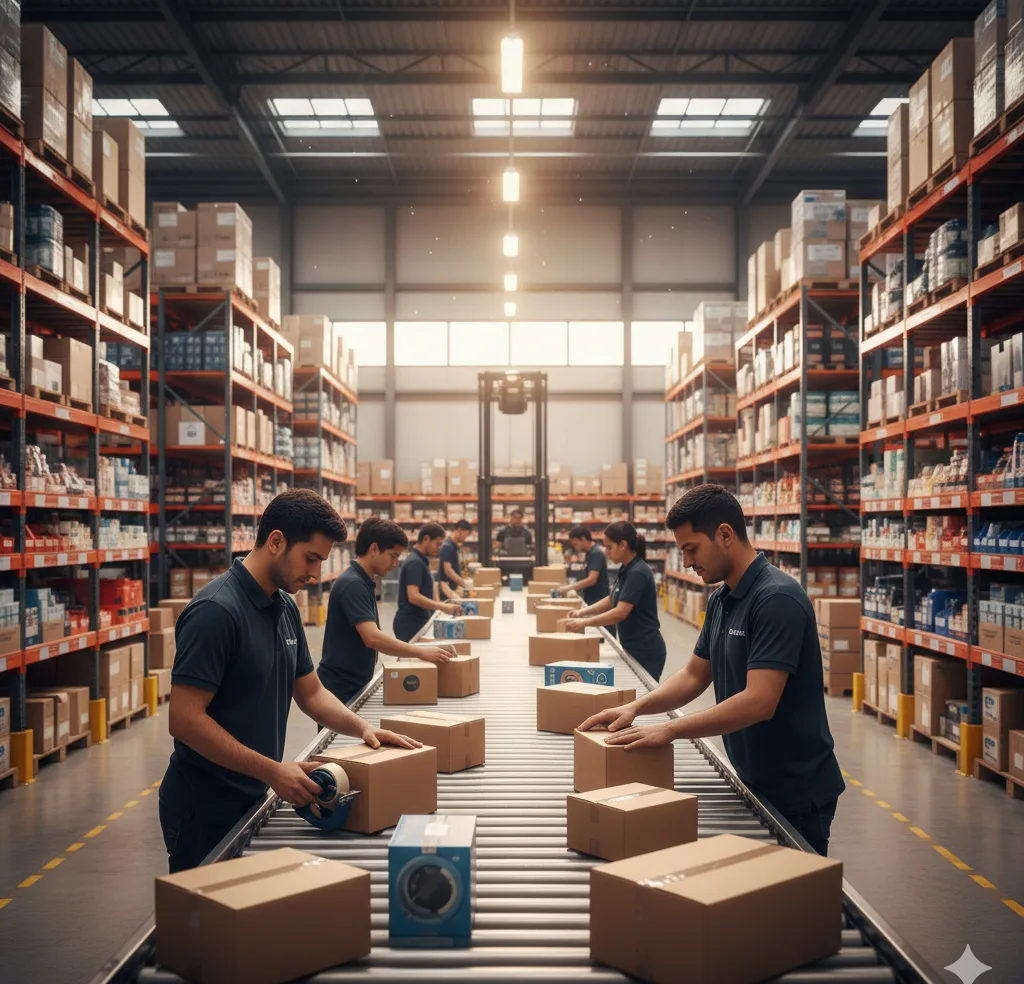
Think of it this way: you supply the product and the customers. The fulfillment partner handles everything in between. Your inventory sits in their warehouse, their team picks and packs each order within minutes, and the parcel reaches your customer through whichever carrier is fastest. You monitor it all through a real-time dashboard — but you do not lift a finger.
That is fulfillment in 30 seconds. The rest of this guide covers the nuances.
The fulfillment process: from click to doorstep
Every fulfillment operation, whether run by Amazon or a regional 3PL, follows the same six-stage pipeline. Understanding it will help you evaluate any provider.
Stage 1 — Goods receipt
You ship your inventory to the fulfillment warehouse. Staff unload it, verify quantities against your packing list, assign barcodes if items do not already have them, and place every unit into a mapped storage cell. A Warehouse Management System (WMS) records the exact shelf coordinates. From this moment, you can see your stock levels in real time.
Stage 2 — Storage
Your products sit in climate-appropriate conditions until a customer orders them. The WMS tracks every unit by SKU, batch, and expiry date. For items like cosmetics or supplements, a FEFO system (First Expired, First Out) ensures you never ship a product that is close to its use-by date. Professional warehouses also run regular cycle counts, so your inventory numbers stay accurate without painful annual stocktakes.
Stage 3 — Order intake
The moment a customer completes a purchase on your website, marketplace, or social media store, the order flows into the WMS via API. No copy-pasting, no manual data entry. The system automatically creates a pick task and assigns it to the next available operator on the warehouse floor.
Stage 4 — Pick and pack
The operator walks to the mapped cell, picks the correct item, scans its barcode (a second confirmation layer that prevents mis-picks), and packs it. Packaging can be generic or custom — branded boxes, tissue paper, thank-you cards, promotional inserts. At MTP Group, the average time from pick task to sealed parcel is 30 seconds per order.
Stage 5 — Shipping
A shipping label is generated automatically through direct integration with the carrier. The parcel enters the outbound queue. Typical fulfillment centers arrange multiple carrier pickups per day — at MTP Group there are four daily pickups, meaning any order received before 14:00 ships the same day. The customer receives a tracking number instantly.
Stage 6 — Returns
When a customer sends something back, the warehouse receives the parcel, photographs the item, inspects its condition, and either returns it to sellable stock or quarantines it as damaged. You see every return in your dashboard with photos and notes. No surprises.
In-house vs outsourced fulfillment
Before you decide to outsource, it helps to understand the trade-offs honestly. Fulfillment is not magic — it is a business decision that makes sense at certain scales and for certain business models.
| Factor | In-house | Outsourced (3PL) |
|---|---|---|
| Startup cost | High (lease, shelving, equipment, WMS license) | Low (pay per order) |
| Fixed monthly overhead | Rent + utilities + insurance + staff salaries | Minimum monthly fee only |
| Scalability | Slow — you hire, train, and equip for each growth step | Instant — the 3PL absorbs volume spikes |
| Control over process | Full — you design every detail | Partial — you set rules, they execute |
| Branding & unboxing | Unlimited customization | Customizable within provider’s options |
| Risk from power outages | Your problem entirely | Provider’s problem (if they have generators) |
| Your time on logistics | 3–5 hours/day | Near zero |
| Best for | Under 10 orders/day or hyper-custom products | 10+ orders/day with standard packaging |
The honest answer: if you ship fewer than 10 orders a day and enjoy the process, in-house is fine. Once you cross 10–15 daily orders, the math starts to favor outsourcing — not just financially, but in terms of the hours you get back. At 50+ orders per day, running your own warehouse becomes a second full-time job that has nothing to do with selling.
How much does fulfillment cost?
Pricing models vary by provider, but a transparent 3PL will publish their rates openly. Here is the real rate card from MTP Group in Ukraine, shown in both UAH and approximate USD equivalents (at the current rate of 44 UAH/USD):
| Service | Price (UAH) | Price (USD approx.) |
|---|---|---|
| Order processing (200+ orders/day) | from 18 UAH | ~$0.41 |
| Order processing (50–199 orders/day) | from 22 UAH | ~$0.50 |
| Order processing (0–49 orders/day) | from 26 UAH | ~$0.59 |
| Storage | from 650 UAH/m³/month | ~$14.77/m³/month |
| Goods receipt | from 3 UAH/unit | ~$0.07/unit |
| Monthly minimum | 5,000 UAH/month | ~$114/month |
Order processing includes picking, packing, packing materials, label generation, and handoff to the carrier. There are no hidden surcharges for “system access” or “account management.”
Example calculation: An online store shipping 100 orders per day at the 50–199 tier (22 UAH per order) over 22 working days spends 48,400 UAH (~$1,100) on order processing, plus storage. Compare that to the cost of renting warehouse space, hiring a packer, buying materials, and losing 90+ hours per month of your own time. At this volume, outsourcing is almost always cheaper — before you even account for the time savings.
Fulfillment in Ukraine: why it is 50% cheaper than EU
If you are an international seller exploring Eastern European logistics, or a Ukrainian seller considering whether local 3PL makes sense, this section is for you.
Ukraine has quietly developed a sophisticated e-commerce logistics sector. The country had over 200,000 active online stores before 2022, and the number has grown since as businesses digitized rapidly. Domestic carriers like Nova Poshta operate 12,000+ branches — more pickup points per capita than most Western European countries — with next-day delivery across the entire country.
Here is why fulfillment in Ukraine offers exceptional value:
Labor costs. Average warehouse wages in Ukraine are 4–5x lower than in Poland, Germany, or the Czech Republic. This directly translates into per-order processing fees that Western European 3PLs simply cannot match. MTP Group charges $0.41–$0.59 per order. A comparable service in Germany runs $2.50–$4.00.
Warehouse costs. Industrial real estate near Kyiv costs a fraction of what you would pay in Warsaw, not to mention Berlin or Amsterdam. Storage at MTP Group is approximately $14.77 per cubic meter per month. In Western Europe, the same space costs $40–$70.
Technology parity. Ukrainian fulfillment operators run the same WMS software, barcode scanning systems, and API integrations as their European counterparts. The technology gap is effectively zero. MTP Group integrates with all major Ukrainian marketplaces (Rozetka, Prom.ua, Kasta) as well as international platforms, CRM systems like KeyCRM and SalesDrive, and shipping APIs.
Scale. MTP Group alone processes 60,000+ shipments per month across 3,900 m² of warehouse space near Kyiv, serving 150+ active clients. Peak capacity reaches 6,000 orders per day. This is not a startup — it is a decade-old operation with the infrastructure to prove it.
For sellers targeting the Ukrainian domestic market, there is no reason to look elsewhere. For international sellers exploring nearshoring or cost optimization, Ukraine represents one of the most cost-effective 3PL locations in Europe.
Choosing a fulfillment partner: the checklist
Not all 3PLs are equal. Use this checklist when evaluating providers — whether in Ukraine or anywhere else.
- Transparent pricing. If the provider hides their rates behind a “Request a quote” form with no published numbers, treat it as a red flag. Good operators publish their pricing openly because they are confident in their value.
- WMS with real-time dashboard. You should be able to log in at any time and see current stock levels, today’s shipments, pending orders, and return status. If the reporting is a weekly Excel file, keep looking.
- API integrations. The provider should connect directly to your sales channels (website, marketplaces, CRM) via API. Manual order entry means human errors and delays.
- Processing speed with a number. Ask “What is your average pick-and-pack time per order?” A good answer is 30–60 seconds. Anything vague like “same-day shipping” without specifics may hide inefficiency.
- Carrier pickup frequency. One carrier pickup per day means any order placed after late morning ships tomorrow. Four pickups per day means a 14:00 cutoff for same-day dispatch. This directly affects your customer satisfaction and marketplace ratings.
- Backup infrastructure. Does the warehouse have generators? Backup internet? What happens during a power outage? In some markets this is nice-to-have. In Ukraine, it is non-negotiable. More on this below.
- Returns workflow. Ask how returns are handled. Is there photographic documentation? Can you set rules for what gets restocked vs. quarantined? Returns are 20–30% of e-commerce volume — a sloppy returns process will cost you.
- Scalability proof. Ask for peak-season numbers. How many orders can they handle per day at maximum capacity? What happened during their last Black Friday? A provider that handles 6,000 orders per day at peak will not break a sweat at your 200.
- References with numbers. “We are the best” means nothing. “Client X grew from 12 to 72 orders per day in 3 months after switching to us” is a verifiable claim with substance.
- Trial period. A confident provider will offer a 1-month trial. If they insist on a 12-month contract before you have shipped a single order, that tells you something about their retention rate.
Power resilience: the Ukraine question
Let us address this directly, because it is the first thing any international client asks.
Since February 2022, Ukraine has experienced periodic power grid disruptions due to the ongoing conflict. For any logistics operation, electricity is not optional — WMS systems need servers, barcode scanners need charging, lights need to be on, and climate control must function. A fulfillment center without power is a warehouse full of boxes that nobody can process.
This is precisely why power resilience is the single most important evaluation criterion when choosing a Ukrainian 3PL.
Here is what MTP Group has in place:
- 3 industrial generators — not portable units from a hardware store, but industrial-grade diesel generators capable of powering the full warehouse operation indefinitely.
- 2 independent fiber-optic ISPs — if one provider goes down, internet switches to the second automatically.
- Starlink satellite connection — a third-layer backup that operates independently of ground infrastructure entirely.
- Result: zero operational downtime since February 2022. Not one day. Not one shift. Orders have shipped every single working day without interruption for over four years.
This level of preparedness is not universal. Many smaller operators in Ukraine do not have this infrastructure and have experienced significant disruptions. The difference between a provider with triple-redundant power and one with a single generator is the difference between a reliable business partner and a liability.
When evaluating any Ukrainian 3PL, ask: “How many days of operational downtime have you had since 2022?” The answer will tell you everything you need to know.
Case study: 6x growth in 3 months
Client: Carter’s — a children’s clothing brand selling through its own website and multiple Ukrainian marketplaces.
Before MTP Group:
- 12 orders per day
- Owner personally handling all packing and shipping
- 3–4 hours per day spent on logistics
- Per-order cost (including time, materials, travel): approximately 30 UAH (~$0.68)
- No time or energy left for marketing, product expansion, or marketplace optimization
After switching to MTP Group fulfillment:
- 72 orders per day within 3 months — a 6x increase
- Per-order cost dropped to 14 UAH (~$0.32) — a 53% reduction
- 90+ hours per month freed from logistics tasks
- All time redirected to advertising, product sourcing, and marketplace ranking
The growth was not caused by fulfillment alone — but fulfillment made it possible. When the owner stopped being a warehouse worker and became a marketer, revenue followed. The lower per-unit cost at higher volumes created a virtuous cycle: more orders meant cheaper fulfillment, which meant higher margins, which funded more advertising, which brought more orders.
This pattern repeats across virtually every client that transitions from self-fulfillment to outsourced 3PL. The constraint is almost never demand — it is operational capacity. Remove the logistics bottleneck, and growth happens naturally.
About MTP Group
MTP Group has operated fulfillment services for over 10 years. The company manages 3,900 m² of warehouse space near Kyiv, serves 150+ active clients, and processes 60,000+ shipments every month. Peak throughput reaches 6,000 orders per day. The operation is backed by triple-redundant power (3 generators), triple-redundant internet (2 fiber ISPs + Starlink), and has maintained zero downtime since February 2022.
Frequently Asked Questions
What is fulfillment in simple terms?
Fulfillment is when an external operator handles all your e-commerce logistics: storing products, picking orders, packing, and shipping to buyers. You focus on sales.
How much does fulfillment cost?
From $0.41/order (200+/day). Storage ~$15/m³/month. Minimum ~$114/month. Includes WMS, packing materials, Nova Poshta shipping.
Do I need a Ukrainian legal entity?
Not to start. The operator can process shipments for your test launch. Register a local entity when volumes grow.
How fast can I get started?
1-3 days: contract, API setup, goods receiving, first shipment. Most clients are operational within 72 hours.
What about power outages in Ukraine?
Professional operators have backup power. MTP Group: 3 generators, 2 fiber ISPs, Starlink. Zero downtime since February 2022.