Kyiv · Ukraine|An op-ed for international brands entering the Ukrainian e-commerce market through its largest marketplace.
01 · INTERACTIVE TOOL
Calculate your savings
A self-managed Ukraine warehouse for a Prom.ua seller costs more than most foreign brands assume. Slide the order volume to see the gap between running it yourself and outsourcing to MTP.
1001,0002,5005,000
Self-managed warehouse$2,361Rent + 2 staff + packaging + lossesMTP Fulfillment$870All-inclusive, no setup, no commissionYou save$1,492 / mo+ 144 staff hours per month
Estimates assume 35 m² leased space at $12 / m² in the Kyiv region (after the strikes on local warehouses, decent space now starts around 500 UAH / m²), two warehouse operators at $620 / month gross, baseline packaging cost $0.18 / order, 1.4% loss rate on self-managed inventory. Run a precise quote in our calculator.
02 · OP-ED
The case for disruption
How Prom.ua’s missing fulfillment layer became the ultimate opening for international 3PL operators.
Ukraine is the second-largest e-commerce market in Eastern Europe.
Roughly thirty million online shoppers, gross merchandise value approaching €11.2 billion in 2024, and a year-over-year growth rate that outpaced every neighbour in the region. The story foreign press tells about Ukraine — war, electricity rationing, attrition — is not the story Ukrainian e-commerce tells about itself. Volumes recovered to pre-2022 baselines in late 2023, exceeded them in 2024, and added another seven percent through Prom.ua alone in 2025. For a Western consumer-goods brand looking for a high-intent, under-served market in the Eastern European arc, Ukraine is the unfilled square on the map.
The largest marketplace in this market is Prom.ua, an EVO-group property hosting more than 700,000 active sellers, more than 100 million product listings, and somewhere between thirty and fifty million monthly visits. By gross volume of independent sellers, Prom is to Ukraine roughly what eBay was to the United States in 2008 — the default merchant gateway for any small or mid-sized brand looking to reach a national audience.
And yet, despite this scale, Prom does something that confuses every foreign operator who studies it for the first time. It does not run its own fulfillment network. No FBO. No FBA-equivalent. No marketplace warehouse. Sellers ship from their own premises, full stop.
“
We replaced our 400 m² warehouse and three staff members with one MTP integration. The Prom token took two minutes to issue.
”
— EU home-goods brand, 2,400 monthly orders on Prom + own Shopify store, twelfth month with MTP, January 2026.
The platform never built one. The market did.
Compare this with Rozetka, Ukraine’s second-largest marketplace, which operates Rozetka Fulfillment — a managed FBO product with curated category restrictions and 4–35% commission. Compare with Kasta, which offers FBK (fulfillment by Kasta) for fashion verticals. Compare with Amazon’s European FBA network, the gold standard most foreign brands assume marketplaces eventually build.
Prom never built it. The reasoning, as Prom’s CPO has stated in several interviews, is structural: Prom is a long-tail aggregator of small merchants, not a curated catalogue, and a managed FBO would force category restrictions that contradict the platform’s open-marketplace identity. The strategic choice is to remain horizontal and let the market provide fulfillment.
The market has provided. There are now twenty-plus 3PL operators in Ukraine offering Prom-compatible fulfillment, of which a handful — including MTP Group — operate at the scale and quality bar that international brands require to onboard without a Ukraine-resident operations director on staff.
What "Prom-compatible" actually means in 2026.
Prom.ua exposes a public API, token-authenticated, with endpoints for orders, products, stock levels, and order-status transitions (Accepted → Completed → Cancelled). There are no webhooks for new orders. The integration pattern is poll-based, every thirty minutes, which feels antiquated to anyone coming from Shopify or Amazon Marketplace Web Services but is in fact perfectly serviceable for a 3PL that processes orders on a thirty-minute cadence regardless. The thirty-minute polling window is shorter than the typical handover-to-courier time at any well-run warehouse.
What is genuinely difficult is the absence of standardised Ukrainian carrier integration on the seller side. A foreign brand selling on Prom must independently integrate with Nova Poshta (the dominant domestic courier, 60% of Ukrainian e-commerce volume), Ukrposhta (the post office), Meest, and increasingly Prom’s own Prom Delivery aggregation layer. Each carrier has its own API, label format, package-tracking schema, and customs-declaration form for the cross-border subset. This is the work that an outsourced 3PL absorbs entirely.
Add the layer of multi-marketplace inventory pooling — most Prom sellers also list on Rozetka, Kasta, Allo, Bigl, OLX, and their own Shopify or Horoshop storefront — and the operational footprint of doing this in-house starts to look indefensible at any volume above a few hundred orders a month. Which is precisely the moment when the calculator above tips definitively in favour of outsourcing.
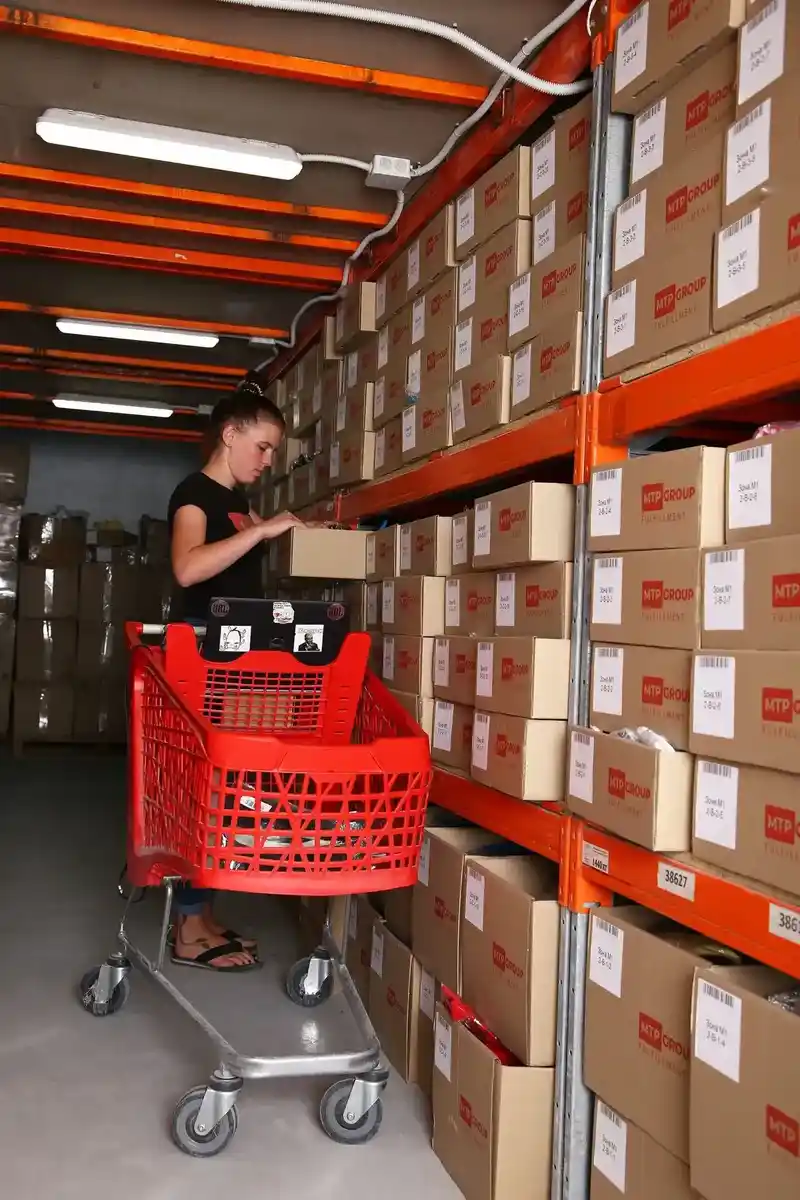
MTP Group warehouse, Boryspil district. Three industrial generators, two Starlink terminals, zero days of downtime since February 2022.
03 · COMMERCIAL
Pricing tiers
Four monthly bands. No setup fee, no commission on sales, no minimum-volume penalty. Currencies in UAH baseline, invoiced in EUR / USD on request.
STARTER$0setup · pay-as-you-go
Up to 200 orders / month
Prom.ua API integration
Nova Poshta + Ukrposhta domestic
Standard packaging
Email + Telegram support
Per-shipment fee from $0.99
For brands testing the Ukraine market on a single SKU range.GROWTH$1.8k/moall-in retainer
Up to 1,500 orders / month
Prom + Rozetka + Kasta APIs
EU carriers (Meest, Nova Poshta Intl)
Custom branded packaging
Dedicated account manager
Per-shipment fee from $0.88
Returns handling, photo verification
Most chosen by EU brands at month four onward.SCALE$7.2k/moall-in retainer
Up to 8,000 orders / month
All marketplace + DTC APIs
DHL / UPS / FedEx (cross-border)
Cold-chain zone access
SLA: 24 minutes order-to-label
Per-shipment fee from $0.73
Quarterly business review
For brands at €1M+ annual Ukraine GMV.ENTERPRISETALKcustom contract
Unlimited order volume
Custom WMS workflows
Dedicated warehouse zone
EU mirror DC (Frankfurt)
SCC + DPA + bespoke SLA
Custom integrations (Odoo, SAP)
White-label fulfillment for resellers
For multi-brand groups and licensed-distribution models.
All bands include WMS dashboard access, real-time stock visibility, photo-verified dispatch, and full contractual liability for your goods. Full price list → · 3PL service overview →
03.5 · INTERNATIONAL OPERATIONS
For brands entering Ukraine through Prom.ua — currency, language, payment terms
Prom.ua is the second-largest Ukrainian marketplace by GMV after Rozetka, with a different audience and a different operating logic. Where Rozetka leans toward urban premium buyers and consumer electronics, Prom is the dominant choice for SMB sellers, regional buyers, and categories like home goods, baby products, and beauty. For an international brand entering Ukraine, choosing Prom over (or alongside) Rozetka often comes down to category fit and seller-fee tolerance — Prom takes 2–5% commission compared to Rozetka 10–15% on most categories.
Currency and payment reconciliation. Ukrainian e-commerce runs primarily on hryvnia (UAH). Cash-on-delivery via Nova Poshta accounts for 60–75% of consumer orders depending on category. Prepaid orders use Ukrainian card networks plus Apple Pay and Google Pay. For international brand owners, this means reconciling foreign-currency revenue against UAH-denominated operating costs. Our invoicing supports USD or EUR billing with NBU monthly reference rates applied transparently to every line item — your accountant sees the conversion factor on every invoice rather than discovering it three quarters later.
Language and customer-service layer. Prom.ua product cards default to Ukrainian or Russian; switching the storefront to English is technically possible but commercially counterproductive — Ukrainian buyers expect Cyrillic text, local pricing, and local customer service phone numbers in product listings. We can manage the Tier 1 customer-service layer in Ukrainian, Russian, and English, dispatched from our Kyiv office. Order-status questions, return requests, and pre-purchase product questions get answered within 4 business hours during weekdays, 8 hours on weekends.
Payment terms for international clients. Monthly invoicing in arrears, net-7 by default with net-30 unlocked after 90 days of clean payment history. SEPA and SWIFT wires are standard; for sub-€15,000 invoices we accept Wise, Revolut Business, and Payoneer to bypass wire fees. Annual prepayment earns a 6% discount; quarterly prepayment 3%. We do not accept crypto. All invoices include a Ukrainian VAT-export note (zero-rated for non-resident clients under Article 195 of the Tax Code), so EU and US clients do not pay Ukrainian VAT on fulfillment service fees.
Compliance and reporting. Prom.ua requires sellers to maintain seller rating above 4.0/5.0, on-time dispatch above 95%, and refund-to-order ratio below 8% on most categories. Our WMS surfaces these metrics in real time on your dashboard, with email alerts when any metric crosses the warning threshold. Quarterly compliance reviews include a 30-minute video call with your account manager covering operational metrics, seasonal forecasts, and pricing-strategy alignment with Prom.ua's category-specific seller scoring algorithm.
04 · CORRESPONDENCE
Questions
From the inboxes of compliance officers, finance directors, and integration leads at brands evaluating Ukraine entry through Prom.ua.
Order data flowing through Prom.ua API contains the buyer's name, phone, delivery address, and email — classic personal data under GDPR Article 4. Our WMS stores this data on Ukrainian servers (Kyiv DC, Tier III equivalent) with encryption at rest (AES-256) and encryption in transit (TLS 1.3). Ukraine is not currently on the EU adequacy list, so for EU-resident buyers transiting through your Prom storefront we sign Standard Contractual Clauses (SCCs, Module 2 — controller to processor) at contract signature. Data retention is configurable per the seller's policy: default is 24 months for order records, 7 days for raw API logs, and zero retention for payment card data (we never see PAN — Prom's payment processor handles that). For brands subject to stricter data-localization rules (German telecom, French health), we offer a Frankfurt mirror via partner DC — order data is replicated nightly and the EU mirror serves as the system of record.
Minimal. Prom.ua issues an API token from the seller cabinet (Settings → API Token Management → Create Token, four clicks, two minutes) and you provide that token to us through an encrypted handover. We poll Prom every 30 minutes for new orders — Prom does not expose webhooks, this is a platform constraint not a limitation of our system. Product catalog and stock levels sync every 3 hours by default, configurable down to hourly for fast-moving SKUs. From token receipt to first parcel dispatched is typically 3–5 business days: day 1 receive credentials and inventory manifest, day 2 receive goods at our Kyiv warehouse, day 3 pilot with 5–10 test orders verifying status mapping (Accepted / Completed / Cancelled), day 4–5 go-live. There is no developer time required from your side — our integration engineer handles the Prom side end-to-end.
We invoice monthly in arrears, net-7 by default with net-30 available after the first 90 days. Currencies: UAH (default), EUR or USD on request with monthly FX averaging from National Bank of Ukraine (NBU) reference rates. SWIFT and SEPA wire are standard; for EU sellers we offer a euro-denominated invoice routed through our partner bank in Lithuania to reduce wire fees and FX friction. Payment via Wise, Revolut Business, and Payoneer is supported up to €15,000 per invoice. We do not accept crypto. Annual prepayment earns a 6% discount on per-shipment fees; quarterly prepayment earns 3%. All invoices include a UA VAT-export note (export of services to non-resident is zero-rated under Article 195 of the Ukrainian Tax Code) so EU buyers do not pay Ukrainian VAT on our service fees.
Prom buyers return through whichever carrier the original parcel shipped on — typically Nova Poshta (≈75% of Prom volume), Ukrposhta (≈15%), Meest, or courier (the remainder). The buyer initiates a return through the Prom seller cabinet or via direct contact, and the parcel is shipped back to our warehouse address (we maintain a dedicated returns dock, separate from receiving, so returns do not contaminate fresh inventory). On arrival each return is photographed, condition-graded (A: resaleable as-new / B: resaleable with discount / C: damaged, customer fault / D: damaged, our fault — at our cost), restocked or quarantined, and the buyer's refund is triggered through Prom's refund flow within the same business day. Return rate by category in our 2025 dataset: clothing 14–22%, electronics 4–7%, home goods 2–4%, supplements 0.8%. We charge 15 UAH per return for grade A/B handling, 22.50 UAH for grade C/D (includes photo documentation for dispute).
Yes — and this is one of the reasons EU brands prefer a Ukraine 3PL over a Polish hub for their Prom.ua channel. We ship via Nova Poshta International (90+ countries, 5–9 days to most EU capitals), Meest (multi-day to UK / DE / PL / FR / Czech), DHL Express (2–4 days, premium), UPS, and FedEx International. Customs declarations are filed by our partner brokers in Kyiv (CMR, commercial invoice, packing list, certificate of origin where applicable). For shipments under €150 to EU consumers, IOSS (Import One-Stop Shop) registration on your side enables VAT collection at point of sale and parcel-level customs clearance — average border-crossing time 6 hours via Korczowa or Ubla. For B2B shipments above €150 we file standard Single Administrative Document (SAD) — typical 18-hour clearance. We handle all paperwork; you receive a tracking number that updates from Kyiv handover to EU final-mile.