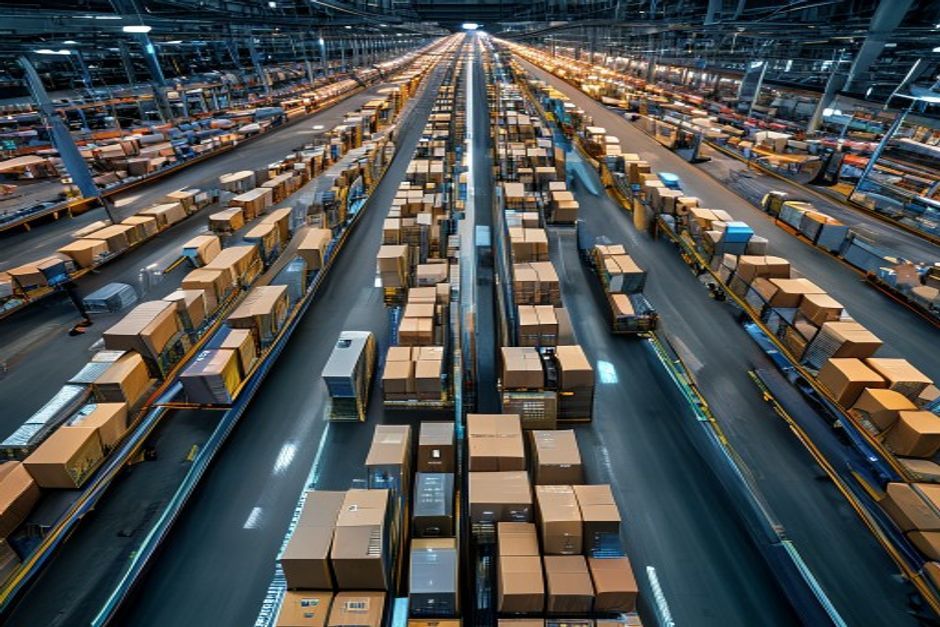
Order Pick and Pack Ukraine — 99.5% Accuracy at $0.41 per Order
Scan-based picking at pick AND pack stages, WMS-routed pickers, QC checkpoint before package seal. 60,000 shipments per month from Kyiv warehouse. 0 days down since February 2022. Structural cost advantage vs US/EU 3PL with no quality compromise.
Why low-cost pick and pack from Ukraine costs $0.41 vs $1.50 US baseline — same pick pack accuracy, structural cost difference
The cost-vs-accuracy table below compares MTP Ukraine 3PL against US and EU industry baselines for equivalent service quality. Quality is not compromised — pick pack accuracy is at industry standard or better. The cost difference comes from warehouse rent, picker labor, and bundled pricing model — three structural factors that produce low-cost pick and pack without sacrificing operational quality.
| Service dimension | UKRAINE 3PL (MTP) | US 3PL (avg) | EU 3PL (avg) |
|---|---|---|---|
| Cost per order (3-4 SKU) | $0.41 | $1.20-1.80 | $1.80-2.50 |
| Pick accuracy (verified) | 99.5% (actual 99.72%) | 99.5-99.8% | 99.5-99.7% |
| Scan verification stages | 2 (pick + pack) | 1-2 (varies) | 1-2 (varies) |
| QC checkpoint | Yes — for $5K+ orders | Varies by provider | Varies by provider |
| Avg pick time per order | 47 seconds | 60-180 seconds | 90-180 seconds |
| WMS routing for pickers | Yes — optimal path algo | Yes (most providers) | Yes (most providers) |
| Pricing model | Bundled per-order | Stacked fees common | Stacked fees common |
| Peak surcharge (Black Friday etc) | None | 15-50% surcharge typical | 20-40% surcharge typical |
| Onboarding time | 3-5 business days | 5-15 business days | 7-21 business days |
| War-resilience track record | 0 days down since Feb 2022 | Untested | Untested |
Six operational reasons in-house pick and pack stops scaling past 50 daily orders
Pick time without WMS routing
On a self-managed warehouse without address storage, the packer spends 5-10 minutes hunting for a low-velocity SKU among shelves. At 100 daily orders that's 8-16 hours of pure search time — one full-time person's day spent looking for inventory. WMS-routed picking takes 47 seconds for a typical 3-4 SKU order. The 6-12x time difference is not micro-optimization — it's a different unit economics model.
Error rate without two-stage scan
Typical pick accuracy on a self-managed warehouse without WMS and barcode scan verification is 95-97%. That's 30-50 errors per 1,000 orders. Each error costs reshipment, return logistics, lost customer (negative review on Google or marketplaces), and risk of full payment refusal. Pick-stage AND pack-stage scan with WMS verification brings accuracy to 99.5% — measured continuously, not aspirationally.
Seasonal peaks break self-managed warehouses
Black Friday, Cyber Monday, Christmas pre-orders — order volume spikes 3-7x. Self-managed warehouse with 2 packers cannot absorb this. Orders ship with 3-5 day delays instead of promised 24 hours. Brand reputation takes a hit at the worst possible moment. MTP capacity is 6,000 orders per day with automatic shift scaling — no peak surcharge in tariff.
Wide catalog with low-velocity long-tail
A merchant with 500-3,000 active SKUs faces a structural problem: 80% of items are long-tail with 1-3 monthly sales but must remain physically stocked for the customers who want them. Without WMS this means either a huge warehouse with manual search or cutting catalog depth. MTP slotting algorithm places hot SKUs near pack stations, long-tail compactly in deep aisles — wide catalog stays operationally manageable.
No quality control checkpoint before seal
Self-managed warehouse typical workflow: packer picks, packs, seals, ships. Errors are not detected until the customer opens the box. MTP has a QC checkpoint — for high-value or multi-SKU orders, a separate controller (not the packer) visually inspects contents before package seal. ~5% of orders go through random QC, 100% for electronics and cosmetics categories. Errors caught at the warehouse, not at the customer.
Self-managed scaling has no linear cost curve
30 daily orders one person handles. 200 needs three packers, a supervisor, additional shelving. 1,000 needs a full department of 8-12 people, dedicated manager, payroll burden, vacation/sick coverage, employee turnover. Each volume tier is a step change in fixed costs, not linear scaling. Outsourced fulfillment removes this ladder — the same per-order tariff applies whether you ship 30 or 6,000 daily.
Why Ukraine 3PL is structurally cheaper than US 3PL — three factors, not one
$0.41 per order from MTP Ukraine vs $1.20-1.80 per order from US 3PL is not a discount or promotional pricing. It's the natural result of three structural cost factors that do not exist in US logistics markets. Understanding these factors helps brands evaluate whether Ukrainian 3PL is sustainable long-term or temporary arbitrage.
Warehouse rent — 60-70% lower than US metro
Industrial warehouse space in Kyiv metro area runs $4-6 per square meter per month. Equivalent space in US logistics hubs (Memphis, Louisville, Indianapolis, Reno) runs $12-18 per square meter. Our 3,700 m² total facility costs roughly the same as 1,200 m² in Memphis. This factor flows directly into per-order cost — storage and operating space is the largest fixed cost in any 3PL business.
Picker labor — 65% lower than US warehouse wages
Ukrainian warehouse picker wages run $400-800 monthly at equivalent skill level (WMS-trained, scanner-fluent, English-capable for international brands). US warehouse worker baseline is $2,400-3,600 monthly with similar productivity. This is not exploitation — it's the real cost of living differential. Ukrainian pickers earn living-wage incomes for their market while we deliver per-order labor cost that US 3PL cannot match structurally.
Bundled pricing instead of stacked fees
US 3PL pricing models typically stack fees: pick fee per line item ($0.20-0.50), pack fee per box ($0.50-1.00), handling fee per order ($0.30-0.75), peak surcharge during Q4 (15-50% on top), occasional pickup fee, occasional storage receiving fee. The "cheap" headline rate becomes $1.50-2.50 effective. MTP bundles all stages into one per-order tariff. The number you see is the number you pay — no Q4 surprises, no per-line-item math, no retroactive surcharges.
How MTP pick and pack works — 8 steps from order receipt to carrier handover
Eight-step workflow from API order receipt to courier handoff. Each step is measured, logged, and auditable. Average pick time on a 3-4 SKU order is 47 seconds.
- 1. Order arrives in WMS. From your e-commerce platform or CRM (Shopify, WooCommerce, Etsy, Amazon Seller Central, custom REST API). Time from customer payment to WMS appearance — 800 ms. Order enters picker queue with priority by SLA.
- 2. WMS routing. The system computes optimal pick path through warehouse aisles. Picker doesn't choose order — the route is pre-calculated to traverse the warehouse once without backtracking. For batch picking (5-10 orders simultaneously), routes are optimized across all orders in batch.
- 3. Picker walks the route. Each picker carries a handheld barcode scanner connected to WMS. Screen shows next bin and SKU to retrieve. Picker walks, takes the item, scans the SKU barcode (pick-stage scan).
- 4. Pick-stage verify. WMS compares scanned barcode to expected SKU. Match — green light, continue to next bin. Mismatch (wrong SKU taken) — red light, operation blocks, picker returns the item and finds the right one. Errors caught at pick stage, not propagated downstream.
- 5. Hand-off to pack station. Completed pick is moved to a pack station — dedicated packer workspace with materials at hand (bubble wrap, three box sizes, branded packaging if configured, void fill, seal tape).
- 6. Pack-stage scan. Before sealing the box, the packer re-scans the barcode of every line item in the order. This is the second independent verification layer — even if pick-stage scan was misread (damaged label, similar code), pack-stage scan catches it. Quantity counts are also verified.
- 7. QC checkpoint (high-value or multi-SKU). For orders over $120 (5,000 UAH) or with 5+ line items — random QC by a separate controller. ~5% sampling rate, 100% for electronics/cosmetics. Controller opens the box pre-seal, visually verifies contents, packaging integrity, presence of branded inserts. Order passes QC or returns to pack station for rework.
- 8. Label print and carrier handover. WMS prints the shipping label with carrier tracking number (Nova Poshta International, Meest, DHL, USPS for US-bound). Box is sealed and labeled. Carrier pickup happens 2-4 times daily. "Shipped" status auto-syncs back to your platform via API.
Four independent verification layers that produce 99.5% pick accuracy as a system property
Pick accuracy is not luck or vigilance of an individual packer. It is a system property created by four independent verification layers. If one layer misses, the next catches it.
Address-based storage in WMS
Every SKU is bound to a specific bin location via ID label. Pickers don't search by memory or eyeball — they walk to the address WMS specifies. This eliminates the "grabbed from the bin next door" error class typical of warehouses without address storage. Slotting algorithm periodically reviews placement by sales velocity — fast-movers move closer to pack station, slow-movers shift to deep aisles.
Pick-stage barcode scan
Mandatory barcode scan when the item leaves the shelf. Scanner pushes the code to WMS, WMS compares against expected SKU. Match — proceed. Mismatch — operation blocks. This catches ~85% of potential errors: similar packaging of different SKUs, misread SKU labels, accidental wrong-bin grabs. WMS will not let the picker continue until the scan matches.
Pack-stage scan before seal
At the pack station, the packer re-scans every line item's barcode. This is an independent second layer — even if pick-stage scan was incorrectly registered (damaged label, similar code accepted by error), pack-stage scan catches the discrepancy. The scan also verifies quantity counts — if customer ordered 3 units and only 2 are in the box, the system warns before seal.
QC checkpoint for high-value orders
Orders over $120 or with 5+ line items get random QC from a separate controller (not the packer). Controller opens the box pre-seal, visually inspects contents, packaging integrity, branded insert presence. Third layer catches errors beyond barcode scope: damaged packaging, missing promotional insert, wrong color of identical-SKU variants. ~5% of standard orders, 100% for electronics and cosmetics.
International brand categories using Ukrainian warehouse pick pack service
EU and US D2C brands testing Eastern Europe
D2C brands evaluating low-cost fulfillment alternatives to ShipBob, ShipMonk, Red Stag baselines. Use MTP for European-bound shipments (Germany, Poland, Czechia, Netherlands) where Ukraine geography is closer than US warehouses. Per-order cost drops 60-75% with no accuracy compromise.
Indie publishers and self-published authors
Independent book publishers shipping to readers worldwide use Ukraine 3PL for cost-effective small-print-run fulfillment. ISBN-based picking, careful packaging to prevent cover damage, photo-documentation on returns. Book fulfillment Ukraine deep-dive for publisher-specific needs.
Etsy and Amazon Handmade sellers
Cross-border craft sellers shipping handmade goods to international buyers. Multi-SKU orders with custom packaging, gift-wrap options, branded inserts. API integration with Etsy seller dashboard via REST. Pick & pack from Kyiv to Berlin in 5-7 days, to NYC in 14-21 days.
Subscription box D2C brands
Monthly subscription boxes (beauty, food, hobby) with fixed SKU rotation per ship period. Multi-pack picking with 100% QC checkpoint (identical box layout makes errors visible), branded packaging, welcome inserts for new subscribers. Separate pipeline with subscription-specific rules.
Cross-border e-commerce native brands
Brands born for cross-border selling, no domestic-only roots. Ship to multiple countries from a single Ukrainian inventory pool. One SKU catalog, one WMS, one per-order tariff plus country-specific carrier rate. Transparent inventory tracking by destination. Low-cost pick and pack at $0.41 enables price competitiveness vs domestic US/EU competitors.
Ukrainian export-oriented brands
Ukrainian-made cosmetics, textiles, and crafts brands selling to diaspora and international buyers. Pick & pack from local Ukrainian warehouse with international shipping integration (Nova Poshta International, Meest, DHL). Avoids the cost of Western 3PL as international destination warehouse.
Pick pack pricing per order — bundled tariff, no stacked fees
One per-order tariff includes: WMS routing, pick-stage scan, pack-stage scan, QC checkpoint, label printing, carrier handover. No separate pick fee, pack fee, handling fee, or peak surcharge.
- Typical 3-4 SKU order
- WMS-routed picker
- Two-stage scan verification
- QC for orders over $120
- Label print and carrier handover
- Same quality process
- Address storage in WMS
- Two-stage scan verification
- QC checkpoint sampling
- Min monthly fee $120 (first 3 mo)
- 8-12 line orders
- Multi-line pick routing
- Pick time 90-120 seconds
- Mandatory QC checkpoint
- Gift wrap optional add-on
Pick and pack integrations for international e-commerce platforms
Pick and pack questions buyers ask before evaluating Ukraine 3PL
What is pick and pack in 3PL fulfillment?
Pick and pack is the operation where a fulfillment center retrieves SKUs from warehouse shelves per a customer order, then packs them into a shipping container with appropriate dunnage. In standard 3PL pricing, often billed as separate line items (pick fee + pack fee + handling fee). MTP bundles all stages into one per-order tariff ($0.41 at 200+ daily volume) including WMS routing, two-stage scan, QC checkpoint, label, and carrier handover.
What is acceptable pick accuracy in 3PL?
Industry standard for 3PL with WMS and scan-based picking is 99.5-99.8%. Without WMS and scan, typical drops to 95-97%. The 0.5% gap represents a 5x error count difference (50 vs 5 errors per 1,000 orders). MTP measured 99.72% in the previous quarter through four verification layers.
How does scan-based picking work?
Every SKU is verified by barcode scan when leaving the shelf. Picker carries handheld scanner connected to WMS. Scan compares to expected SKU — match proceeds, mismatch blocks. Pack-stage scan repeats verification at packing. Two independent layers eliminate the entire error class of "grabbed similar SKU from nearby bin."
What is the difference between pick and pack?
Pick is retrieving SKUs from storage per order. Pack is placing them in shipping container with void fill. In 3PL pricing often charged separately. MTP bundles into single per-order tariff for predictable invoicing.
Who pays for picking errors in 3PL?
At MTP, picking errors are our liability. Confirmed errors (customer photo + WMS log) trigger free reshipment of correct item, free return logistics, and merchant reimbursement for original shipping. SLA 24 hours from report to corrected shipment. Documented in contract with material liability — not marketing promise but legal obligation.
Why does Ukraine pick and pack cost $0.41 vs $1.50 US baseline?
Three structural factors: warehouse rent 60-70% lower than US metro 3PL space, picker labor 65% lower than US warehouse wages at equivalent skill, bundled pricing instead of stacked fees common in US 3PL. Combined gives $0.41 vs $1.20-1.80 US baseline. Quality not compromised — 99.5% accuracy with two-stage scan is industry standard or better.
Is Ukrainian fulfillment reliable for international shipping during wartime?
0 days of fulfillment downtime since February 2022, 60,000 orders monthly. Both warehouses operate with backup generators, Starlink redundant internet, on-site fuel reserves. International shipments (Nova Poshta International, Meest, DHL) continue with stable transit times: Poland 5-7 days, Germany 7-10, USA 14-25, Canada 14-21.
What is the minimum order volume for Ukraine pick and pack?
Minimum monthly fee 5,000 UAH (~$120) for first 3 months, equivalent to ~30-40 daily orders. No fixed lower bound on SKU count. Small subscription brands, indie publishers, D2C startups all use MTP at this entry tier.
How fast can we onboard to MTP pick and pack?
3-5 business days from contract to first picked order for catalogs under 1,000 SKU. Sequence: contract + SKU catalog handover, inbound receiving and address-storage, API integration, end-to-end test order, go-live. Larger catalogs (1,000-10,000 SKU) take 7-10 days.
What carriers do you ship through internationally?
Nova Poshta International (Europe and select global), Meest (worldwide), DHL Express (premium global), USPS (US-bound), Ukrposhta International (cost-effective small parcels). Carrier choice configurable per order or per SKU category.
Other operations in the MTP fulfillment portfolio
Order pick and pack Ukraine — structural cost arbitrage with no quality compromise
International e-commerce brands evaluating fulfillment options face a binary perception: cheap providers compromise quality, premium providers compromise margins. Ukraine 3PL breaks this binary because the cost advantage comes from structural factors — warehouse rent, picker labor, bundled pricing — not quality cuts. MTP delivers 99.5% pick accuracy (industry standard) at $0.41 per order (60-75% below US/EU baselines).
Pick and pack accuracy is a system property, not luck. Four independent verification layers — address storage in WMS, pick-stage barcode scan, pack-stage barcode scan, QC checkpoint for high-value — produce measured 99.72% accuracy without depending on individual packer vigilance. If one layer misses an error, the next catches it. This is the same architecture used by premium US/EU 3PL providers; the cost difference comes from where the warehouse is located and what the pickers earn, not from skipped quality steps.
War-resilience is a structural differentiator that Western 3PL cannot offer because they have never been tested. MTP has shipped 60,000 orders monthly since February 2022 with zero days of fulfillment downtime. Backup power generators, Starlink redundant internet, on-site fuel reserves keep both warehouse facilities (Shchaslyve 2,700 m² and Bilohorodka 1,000 m²) operational through grid disruptions. International carriers (Nova Poshta International, Meest, DHL) continue scheduled pickups. Brands using Ukrainian 3PL during wartime have proven operational continuity that US/EU competitors can only assume.
MTP fits brands shipping 30-6,000 orders daily with 50-10,000 SKU catalogs. Onboarding takes 3-5 business days. Integrations are native for Shopify, WooCommerce, Etsy, Amazon Seller Central, BigCommerce, Magento, with REST API for custom platforms. Pricing is bundled per-order without stacked fees, peak surcharges, or SKU change penalties. Get pricing for your specific catalog and volume — the form above returns a tailored quote in 15 minutes during business hours.
See also: full services portfolio, pricing calculator, 3PL logistics overview, book fulfillment Ukraine, about MTP.